


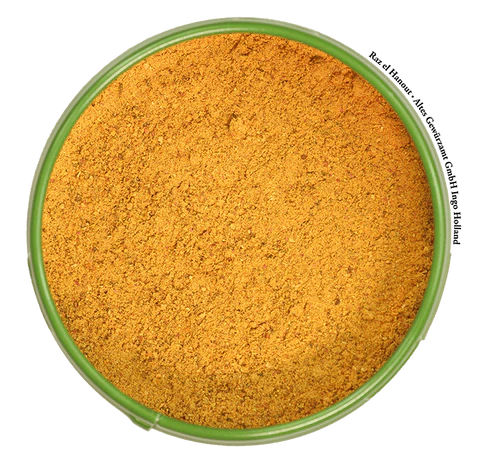


Raz el Hanout

You will receive 64 enjoyment points
Moroccan king of blends with 25+ components, floral and warm for tagine.
- Over 25 components with orris root, rose petals and galangal
- Floral, warm and complex with fine sweetness instead of heat
- A classic for couscous, tagine, lamb ragout and kebab
- Also for meatballs, roasted vegetables and yoghurt marinades
Inhalt: Available in 70g, 35g and 6g.

+ 18,667 positive reviews
-
 Free shipping from 49 €
-
 Manufactured in Klingenberg am Main
-
 Free from additives


Raz el Hanout, the Moroccan king of blends for couscous and tagine
Raz el Hanout (Arabic for “head of the shop”) is the royal spice blend of North African cooking, uniting more than twenty-five ingredients in a single composition. We compose it in our workshop in Klingenberg am Main: orris root and rose petals give the fine sweetness, cumin and galangal the earthy depth, star anise and cinnamon the warmth. A floral, warm and complex blend that turns any braise into a little journey to Marrakesh.
How to use
A Moroccan spice blend for couscous, tagine, kebab and lamb. Also for poultry, meatballs, vegetable stews, roasted carrots, sweet potatoes and chickpeas. Sweat briefly in hot oil or add straight to the braise.
Important: Raz el Hanout is very aromatic. Work your way up carefully, half a teaspoon per person is usually enough to start.
Lamb tagine in five steps
- Cut lamb shoulder into pieces, sear sharply in olive oil and remove.
- Sweat one onion and two cloves of garlic in the same pan, add a tablespoon of Raz el Hanout and sweat for a minute.
- Return the lamb to the pot, deglaze with 400 ml stock, add a handful of dried apricots or dates.
- Braise gently over low heat for 90 minutes, until the meat falls apart tender.
- Season with fine Luisenhaller deep-rock salt and serve with couscous and fresh mint.
At a glance
- Moroccan spice blend with more than twenty-five ingredients
- Floral, warm and complex with orris root and rose petals
- Workshop quality from Klingenberg am Main
- No flavour enhancers, anti-caking agents or additives
- Versatile as a couscous, tagine, kebab and lamb seasoning
Goes well with
If you want more oriental depth, reach for our Baharat blend with its pepper component. For a citrus-sour freshness over the finished dish, our Sumac is ideal. As a sweet-fruity companion to tagine and couscous, our Mango Chutney is perfect. To add fermented umami depth, combine with our Vadouvan. Find more in our spice blends collection.
Frequently Asked Questions
What does Raz el Hanout mean?
Literally it means “head of the shop” and, in Arabic usage, refers to the best a spice merchant has in stock. Every Moroccan spice trader has their own recipe, often with more than thirty components. The name stands for top quality.
What can I use Raz el Hanout for?
Classically for couscous, tagine and lamb braises. Also for meatballs, roast poultry, vegetable stews, roasted carrots and sweet potatoes, in yoghurt marinades and for spiced rice. Excellent as a seasoning over roasted chickpeas as a snack, too.
How hot is Raz el Hanout?
Mild to medium. The blend contains chilli, black pepper and galangal, but is less hot than an Indian curry. Warmth, sweetness and complexity are in the foreground, not heat.
What's the difference from curry blends?
Curry blends like our Curry Mumbai or Curry Anapurna are Indian in character, with fenugreek, turmeric and more heat. Raz el Hanout is North African, more floral through violet and rose petals, with pronounced sweetness and warmth rather than heat.


